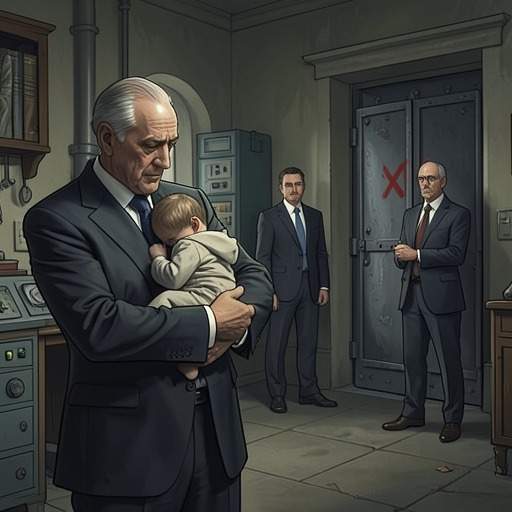
Captivity
MARRIED TO MY MASTER: A Bad Boy Hitman RomanceCaptivity is presented across these story premises as both physical confinement and a struggle over who gets to decide what happens next. Its forms range from being tied or cuffed to being held in a clubhouse basement or described as caged; its stakes include interrogation, control, protection, and escape. The excerpts concern separate narratives rather than one continuous captivity, and several leave the captive’s eventual fate unresolved.
Forms and Circumstances
One premise begins with a man fleeing the law who comes across a woman burning her ex’s car at a desert bonfire. He regards her as a loose end, ties her up, and keeps her cuffed while deciding what to do with her. His thinking changes as he watches her: instead of treating her as disposable, he begins to see her as a prize. The shift does not end her confinement; it recasts the captor’s rationale for keeping her.
Other passages make restraint part of a deliberate bargain. A woman whose larger ambition is to leave her backwater town encounters a professor who tries to force himself on her, then turns to Rip for protection. The premise makes clear that the protection comes at an extreme price: control over her mind, body, and reproductive future. Captivity here is not described only as a locked room or set of restraints. It also takes the form of a relationship in which safety is made conditional on submission.
A separate mistaken-identity premise begins with a whorehouse, a police raid, and confusion about who a woman is. She ends up tied to the bed of Connor Ryan, a biker determined to extract the truth from her. Another blurb says that a woman who has spent years running from her past is handed over to Connor after a betrayal; he intends to make her confess and escalates his pressure when she resists. These accounts present interrogation as a central purpose of confinement, while leaving the full circumstances and outcomes of the questioning unspecified.
Control, Threat, and Bargain
The excerpts repeatedly connect confinement with an imbalance of power. One captor says he will keep a woman tied up until she gives him what he wants: a baby. In another premise, the captive recognizes that she should run, scream, or fight after being kidnapped, yet believes she will not leave. The gap between the choices she identifies and the choice she expects herself to make establishes captivity as a condition that constrains agency as well as movement.
The reproductive stakes are explicit in the premise for Chopper’s Baby, which describes a woman as kidnapped and pregnant by her captor. A different passage concerns Spike Lawler, who claims a woman as his old lady before she knows how to resist and says he will never let her go. When he discovers that she is pregnant, the remaining opportunities she sees for escape close further. The supplied material does not describe the pregnancy as a release from captivity; instead, it presents it as increasing the captive’s sense that escape is becoming less possible.
Captivity can also be used to extract an apology or exert leverage. After a woman steals from him, one man chains her in a dungeon and makes her beg for forgiveness. When he learns that Don “Daddy” Williams wants his best working girl back, he faces a choice. The passage ties the captive’s predicament to competing claims over her, but does not reveal what choice the man makes or what happens to her afterward.
Captivity as Leverage in Conflict
In a power struggle, the captive may be treated as a means of influencing someone else. One man arranges to have an opponent’s old lady tied up in a clubhouse basement; when he goes to interrogate her, he realizes she is not merely a pawn. This recognition changes how the captive is framed within the conflict: her significance exceeds her usefulness as leverage, although the excerpt does not explain what that significance is or how the realization changes events.
A smuggling-route plot offers another version of the same strategic use. The speaker plans to kill Joey Banks and take the route for himself, then says that a woman who might have made a good partner has turned against him. With a siege called and a fight to escape ahead, he intends to take her with him. The captive is thus embedded in a larger contest over power and escape; the passage establishes the captor’s determination, not the woman’s consent or the eventual result.
Narrative Pattern and Limits
Across these separate premises, confinement moves between restraint, threat, and possession. Tying, cuffing, chaining, and caging make the loss of physical freedom concrete; demands for a confession, a baby, forgiveness, or continued obedience show the different purposes assigned to that control. In some accounts, the captor presents himself as a source of protection; in others, the captive is made a bargaining instrument in a conflict or an object to be retained. These are distinct situations, not stages in one character’s experience.
The excerpts often end at a point of pressure: a captive is still restrained, escape seems to be narrowing, a captor faces a choice, or a siege is about to force action. They do not consistently establish whether the captive escapes, is released, or remains confined. Captivity therefore functions here as an unstable story condition whose immediate meaning is clear—freedom has been curtailed—but whose consequences and resolution depend on narratives beyond the supplied passages.